
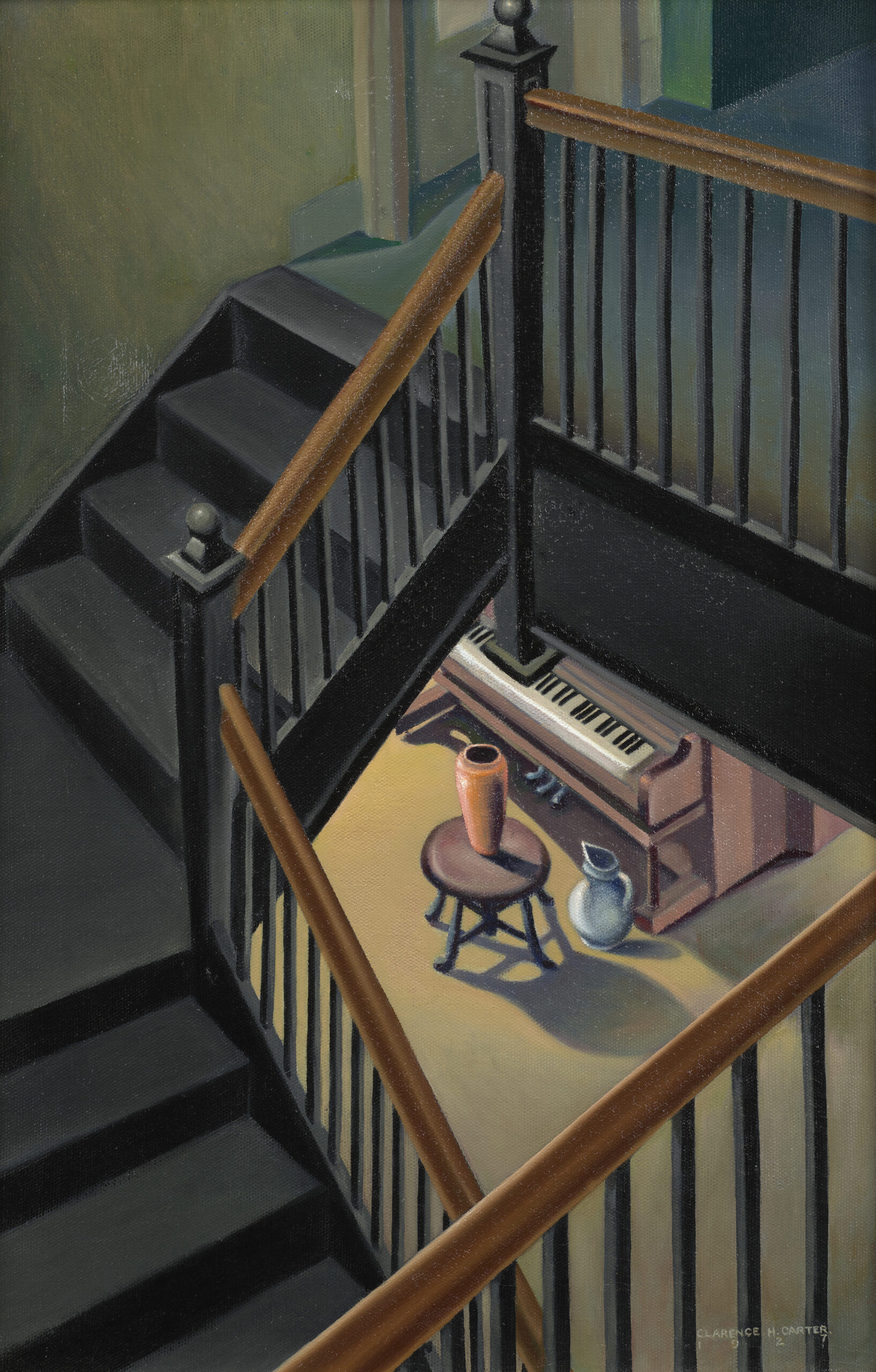
Stairwell at the Cleveland School of Art, 1927
Clarence CarterOil on canvas
24 1⁄8 × 16 1⁄8 inches
Signed and dated to lower right: Clarence H. Carter 1927
Signed to stretcher verso: Clarence H. Carter
Stairwell at the Cleveland School of Art is a remarkable painting created in Carter’s final year as a student, just before his transformative summer with Hans Hofmann in Capri. The work demonstrates the precise observational skills and compositional intelligence that would define his career, while also revealing his early fascination with architectural space as psychological territory.
The painting presents a vertiginous view down a stairwell, its geometric railings and angular turns creating a dynamic study in perspective and spatial recession. The muted palette of grays, blacks, and warm wood tones establishes an atmosphere of quiet contemplation. At the landing below, a still life arrangement—a stool, a piano, and a ceramic vessel—creates an unexpected moment of domestic intimacy within the institutional architecture.
The composition’s dramatic diagonal thrust and flattened color planes show Carter already thinking about modernist spatial construction, even as his technical precision remains rooted in academic training. The empty stairwell suggests absence and transition, themes that would haunt Carter’s work throughout his life. There’s something uncanny in the silence of the space, the way ordinary objects take on symbolic weight when isolated and framed by stark geometry.
This painting anticipates the architectural exercises Carter would undertake with Hofmann in Capri just months later, where he would further explore how stairs, walls, and compressed spaces could become vehicles for emotional and psychological content. It also prefigures his lifelong interest in placing familiar objects in thought-provoking situations—what would later be termed “Magic Realism.”
Stairwell at the Cleveland School of Art captures a young artist on the threshold of mastery, using the architecture of his own school as both subject and metaphor. The stairwell itself becomes an image of artistic ascent, of the passage between student work and mature vision. Painted at age 23, it demonstrates why Milliken recognized Carter’s extraordinary potential and why his career would unfold with such remarkable success.