
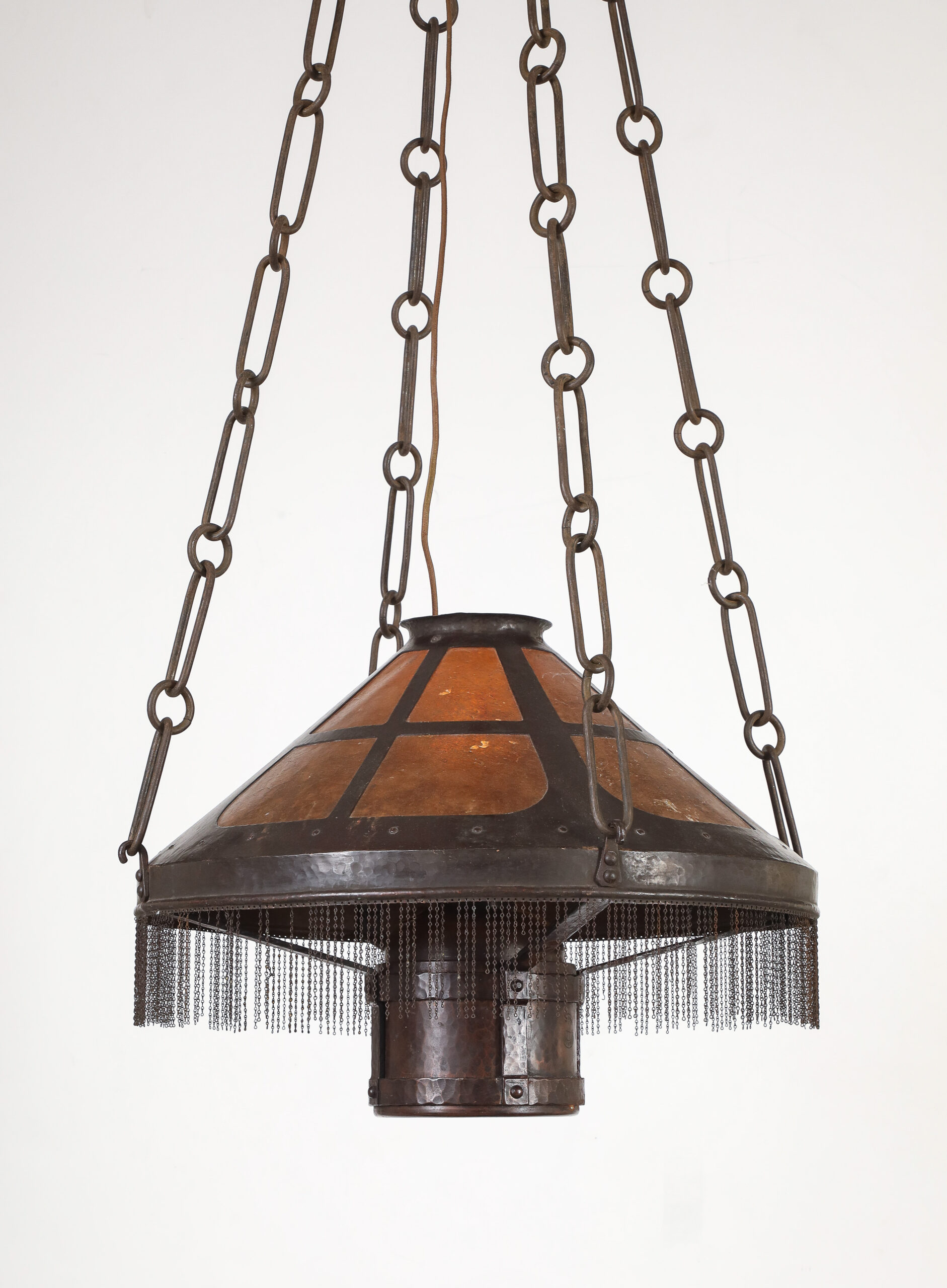
Hanging Chandelier, model no. 291, 1904
Gustav StickleyCopper and mica
51 1⁄2 × 21 × 21 inches
Marked: Impressed with Stickley mark
Characterized by minimal, rectilinear lines, Stickley’s design style focused on emphasizing the inherent beauty of the object’s materiality and functionality; in this view, applied decoration was perceived as hiding rather than enhancing the work’s aesthetic appearance. Likewise, Stickley believed that the color scheme of his furnishings should be subdued and monochromatic, in an attempt to be as natural as possible.
This hanging chandelier, with its entirely original components, is an excellent example of Stickley’s design principles. Made from copper and mica, the earthy brown and red materials gently complement his furniture rather than compete for attention. Strong and pliant, the mica sheets provide a warm translucent glow when viewed by transmitted light. The use of mica in lampshades gained favor during the Arts and Crafts period not only for its soothing lighting effects, but also for its natural origins.
Featuring a short, articulated cap and a double row of shade straps, the chandelier’s conical shade is held by four straight copper arms extending from its base. Suspended by a group of four heavy, linked chains, the shade incorporates a row of metal fringe, made from smaller linked chains, around its circular rim. Supporting the chandelier’s singular socket, the squat cylindrical base shows the structural components of the lamp, such as rivets, calling attention to the beauty of utility.
The chandelier’s base and the circular rim of the shade are produced from hand-hammered copper, a textural material that beautifully expresses Stickley’s concern for handcrafted objects. In contrast to the pre-industrial practice of planishing objects to a smooth, bright finish, which accomplished the ideal of a perfected surface, Arts and Crafts designers left visible the hammer marks as evidence that the work had been created by a person’s hand rather than a machine. The chandelier is believed to be one of only two that exist; the other is housed in the Crabtree Farm Collection in Chicago.