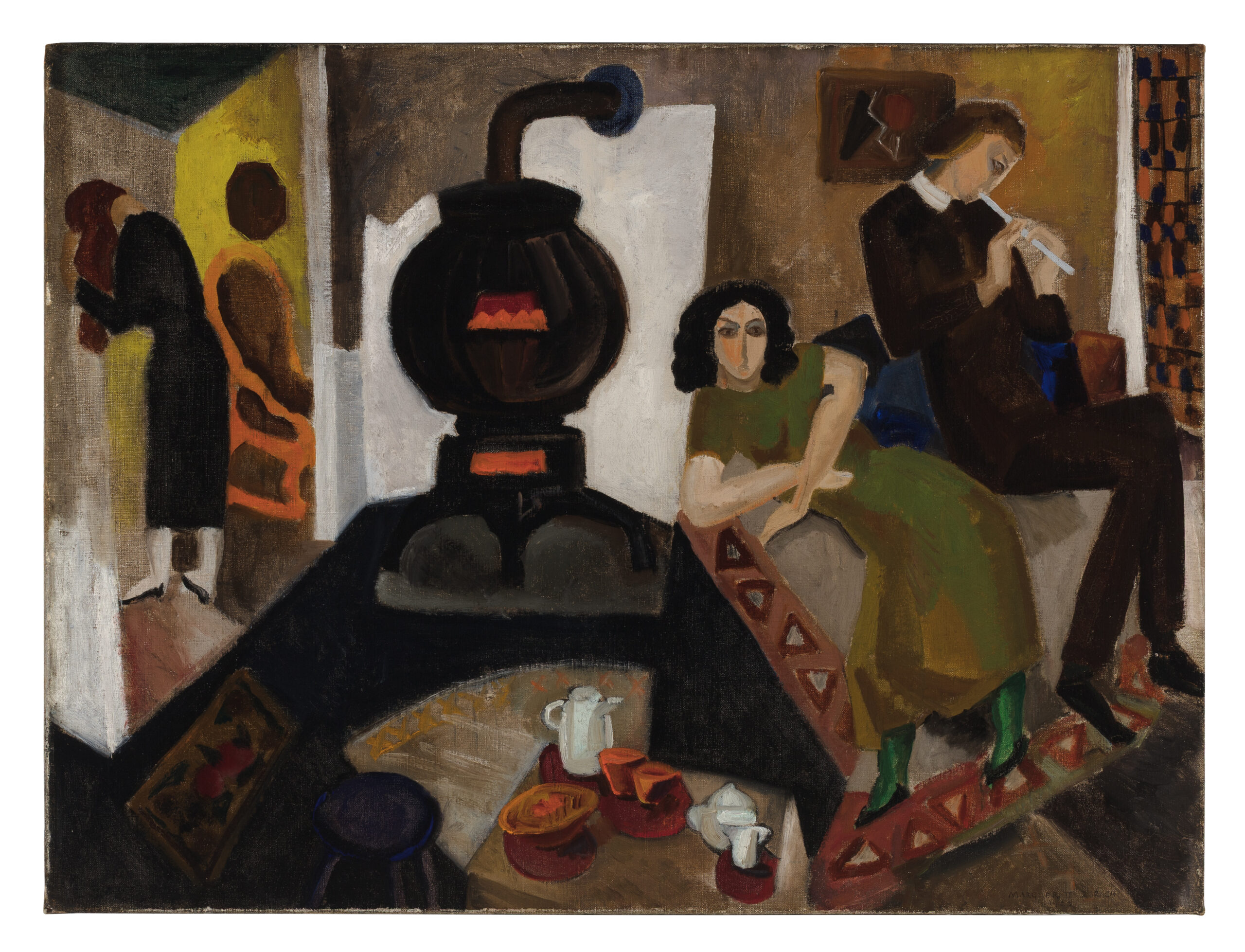
| After marrying in 1912, Marguerite and William Zorach settled at 123 West 10th Street in Greenwich Village, at the heart of New York’s avant-garde art scene. Their home became a meeting place for artists, reminiscent of the small Parisian salons where creatives collaborated and shared ideas. West 10th Street captures a vivid slice of that bohemian domestic life. The cast iron pot-belly stove glowing with fire is the literal and emotional center of the composition — a hearth around which this creative community gathered. Their circle included artists such as Max Weber, Abraham Walkowitz, Marsden Hartley, Charles Demuth, and Gaston Lachaise, who had a studio nearby on West 8th Street.
Marguerite Zorach was among the first artists to bring Fauvism and Cubism to American audiences, and both movements are visible here in the flattened forms, angular figures, and richly saturated palette of ochre, green, and burnt orange. Though she received prominent attention at the landmark 1913 Armory Show — more than her husband — her reputation was long overshadowed by his. Today she is recognized as a pioneering figure of American modernism. Exhibited in museums worldwide, she is considered — alongside Georgia O’Keeffe and Agnes Pelton — one of the most transformative American women artists of the 20th century. |