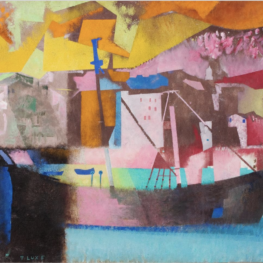
T. Lux Feininger
1910 - 2011
T. Lux Feininger was born in 1910, the son of Lyonel Feininger, one of the first painters Walter Gropius appointed to teach at the Bauhaus when the school was founded in Weimar, Germany. Raised in a profoundly creative household, his childhood coincided with World War I, and the Nazis rose to power in his early adulthood.
As a student at the Bauhaus, Feininger compiled an invaluable and visually distinctive photographic record of the artistic avant-garde in Germany between the wars. As one curator noted, he merged photojournalism with the New Vision aesthetic of exaggerated angles, extreme close-ups, and cropping — capturing student life in a sophisticated, innovative way, even though he was totally untrained.
He turned to painting in 1929 and developed a pictorial language all his own, exhibiting initially under the pseudonym Theodore Lux. He became the first of his family to leave Germany, moving to the United States in 1936.
His first solo exhibition followed at the Julian Levy Gallery in New York in 1947, after which he held successful teaching posts at Sarah Lawrence College, Harvard University, and the School of the Museum of Fine Arts, Boston. He kept painting until a couple of years before his death, and died in his Cambridge home in 2011.