August Biehle
1885-1979
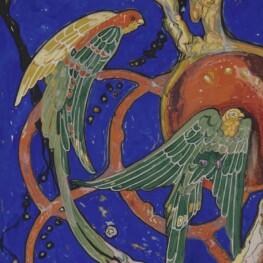
August Biehle was part of the “Cleveland School,” a group of modernists who dominated the scene in Cleveland during the first half of the 20th century. He produced a large volume of work which often reveals his experiments with different styles, including Art Nouveau, Post-Impressionism, and Cubism. Art Nouveau was his first and most important influence, Post- Impressionism helped to brighten his palette, and Cubism dominated his later abstract works.
In 1903, when Biehle was 18, the young Biehle set out for Europe to further his education. Like most young American artists of that time, he went to Paris. However, he soon moved on to Munich where he was more familiar with the country’s language and customs. Most of his teachers during his formative years in Germany were part of the Art Nouveau movement. They were concerned with abstracting nature into simple, flat shapes to make them easily recognizable and printable. This style gave their art a certain poster-like appearance. For Biehle this decorative linearism, emphasizing flat geometric shapes and evenly applied colors, formed a method which he continued to use intermittently throughout most of his life.
After his return to the United States later in 1912, Biehle settled in Cleveland where the artistic climate was quite stimulating as most artists were aware of the modern trends in Europe. Like other American artists at the turn of the century, many Cleveland artists studied abroad for considerable lengths of time, either in France, which was considered the center of modern art activity, or in Germany, which was more appealing to artists with a German background, such as Biehle.
Biehle met many of these artists at the Kokoon Arts Club, a club for the avant-garde of Cleveland founded in 1911. Artists who had to work during the day gathered at the Kokoon Club in the evening to draw and paint. The club provided models and space for periodic exhibitions. But most importantly, these artists inspired one another. They analyzed the new ideas they had acquired on different trips abroad; they were supportive of daring new concepts and discussed artistic problems.
About 1913, Biehle’s style changed. His colors became brighter and less descriptive, and he began to translate the object into rythmic patterns. During 1913, his sketch books show him experimenting with brilliant, pure hues in landscapes similar to those of Kandinsky in his early period. Several sketches of corn shocks, woods, and buildings are composed of brilliant pinks, lemon yellows, and cadmium oranges.