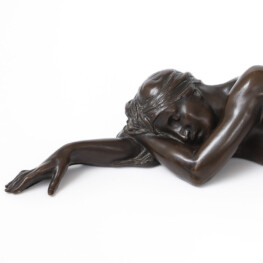
Abastenia St. Leger Eberle
1878-1942
Abastenia St. Leger Eberle was born on April 6, 1878, in Webster City, Iowa, spending her formative years in Canton, Ohio, and Puerto Rico, where she began sculpting clay studies of the everyday life she observed around her. Her father, a doctor, took her on house calls — including to the home of a sculptor who first inspired her artistic path. She studied locally with artist Frank Vogan before enrolling at the Art Students League in New York City in 1899, where she trained under George Grey Barnard, Kenyon Cox, and C.Y. Harvey.
Eberle received immediate recognition for her bronze sculptures and found inspiration in New York’s urban communities, depicting immigrant women and children at work and at play in the Lower East Side and West Village — neighborhoods she herself inhabited. In 1904 and 1905 she collaborated with Anna Hyatt Huntington on group sculptures, with Eberle sculpting the human figures and Huntington modeling the animals.
Her body of work is widely seen as a sculptural counterpart to the paintings of the Ashcan School, sharing its focus on lowly urban scenes and unvarnished depictions of the poor. Eberle believed that art should have a social function, writing that artists “had no right to work as an individualist with no responsibility to others.”
Her most provocative work, White Slave, was her entry in the 1913 Armory Show and shocked audiences by depicting a girl being sold into sexual slavery. Women’s issues dominated both her artwork and personal politics; in 1915 she organized an exhibition of female artists at the Macbeth Gallery to raise funds for woman suffrage.
Eberle later developed a heart condition that limited her work, but she remained active in art organizations and donated twenty-one sculptures to her hometown of Webster City, Iowa. She died on February 26, 1942.