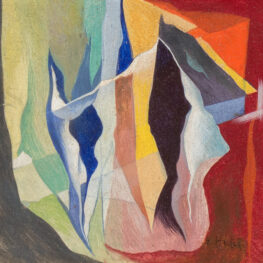
Earl Horter
1880-1940
Earl Horter was a Philadelphia based artist and collector of early twentieth-century American and French art, African sculpture, and Native American artifacts, with a particular interest in Cubist works by Pablo Picasso and Georges Braque from 1909 to 1914. Over the span of just a decade, Horter assembled one of the largest collections of modern art in the United States.
Horter studied at the Art Students League in 1908 and regularly showed his work at the annual Exhibition of Advertising Art at the National Arts Club. In 1913 he also began collecting after visiting The International Exhibition of Modern Art (also known as the Armory Show), where he purchased a suite of thirteen works on paper by Edouard Vuillard. In the following years, he began frequenting such galleries as Alfred Stieglitz’s 291, Macbeth, Montross, Berlin Photographic Company, and Washington Square’s collection of African sculpture.
Horter returned to Philadelphia in 1916 and began socializing with the “Thirty-One Philadelphia Artists,” a group (including Charles Demuth and Charles Sheeler) who had trained at the Pennsylvania Academy of Fine Arts. Through this circle, Horter met Arthur B. Carles, who had studied in Paris from 1907 to 1912 and knew American collectors Gertrude and Leo Stein personally. Carles further exposed Horter to European contemporary art, particularly Cubist works by Braque and Picasso. In the early 1920s, although Horter had been collecting American art since 1913, his focus turned toward European modernism.