
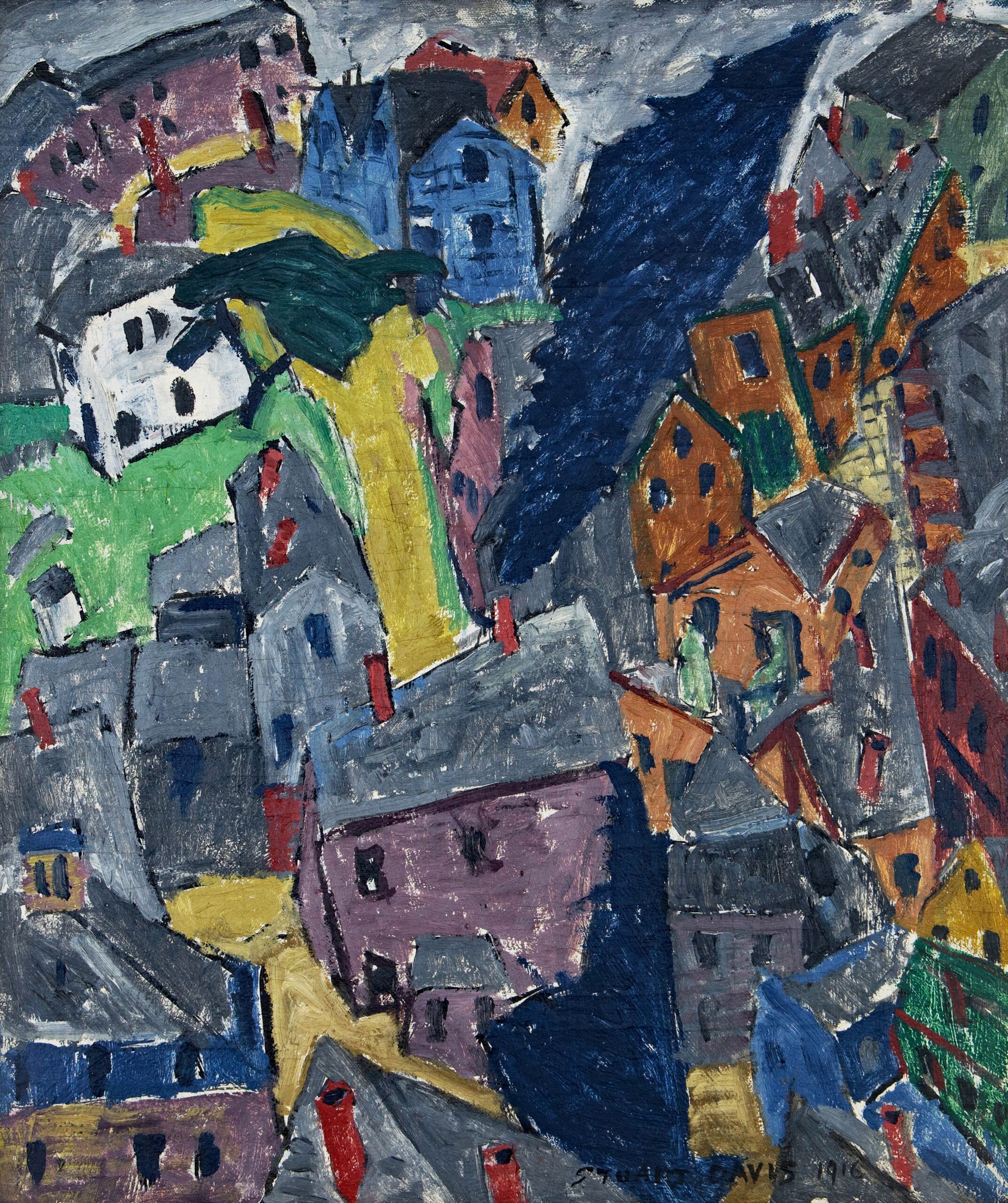
Rocky Neck, Gloucester, 1916
Stuart DavisOil on canvas
23 × 19 inches
Signed and dated (lower right): Stuart Davis 1916
Provenance
The Regis Collection, Minneapolis, 1996
Private collection, Palm Beach, 2001
This striking representation of Gloucester was painted by Stuart Davis during the summer of 1916. Rocky Neck, Gloucester, a relatively early work in Davis’s oeuvre, bears hallmarks of youthful experimentation. At this moment, Davis was working through diverse influences from European art, which he had seen three years earlier at the International Exhibition of Modern Art (The Armory Show of 1913). While Davis had been aware of modern styles such as Post-Impressionism, Fauvism, and cubism, the opportunity to see so much of this work in one exhibition had an enormous impact on his style. He stated,
“I was enormously excited by the show and responded particularly to Gauguin, van Gogh, and Matisse because broad stylization of form and the non-imitative use of color were already practices within my experience. I also sensed an objective order in these works which I felt was lacking in my own . . . I resolved that I would quite definitely have to become a ‘modern artist.”
Compositionally, Rocky Neck, Gloucester, is daring and dramatic. Seen from a nearly arial vantage point, Davis amasses all the buildings on top of one another into a compact neighborhood that spans the entire canvas. Doors, windows, and chimneys spot across the colorful building facades. A yellow road winds and fractures between the buildings as it cascades down the left side of the painting pressing buildings to the side and up against the water’s edge. Secondary to the architecture of Gloucester, Davis has composed the water from ribbons of expressive thick paint in dark blues.
Davis’s artistic influences are palpably visible. Broad areas of incongruent, expressive, flat color in the buildings remind us of Gauguin, van Gogh, and Matisse, the triumvirate quoted from Davis above. The thick and energetic paint application and the simplified shapes of the pictorial elements are further lessons gleaned from these sources. Similarly the compressed and tilted picture plane is reminiscent of modern French art.
A human presence is limited to the impression of two small figures in green, perched on a balcony on the center right. Davis was clearly more interested in a formal exploration of the shapes of the buildings, discordant colors, and the water. Painted six years after he started art school and yet remarkably successful, Rocky Neck, Gloucester testifies to the achievements of Davis’s extraordinary skill and confidence.