
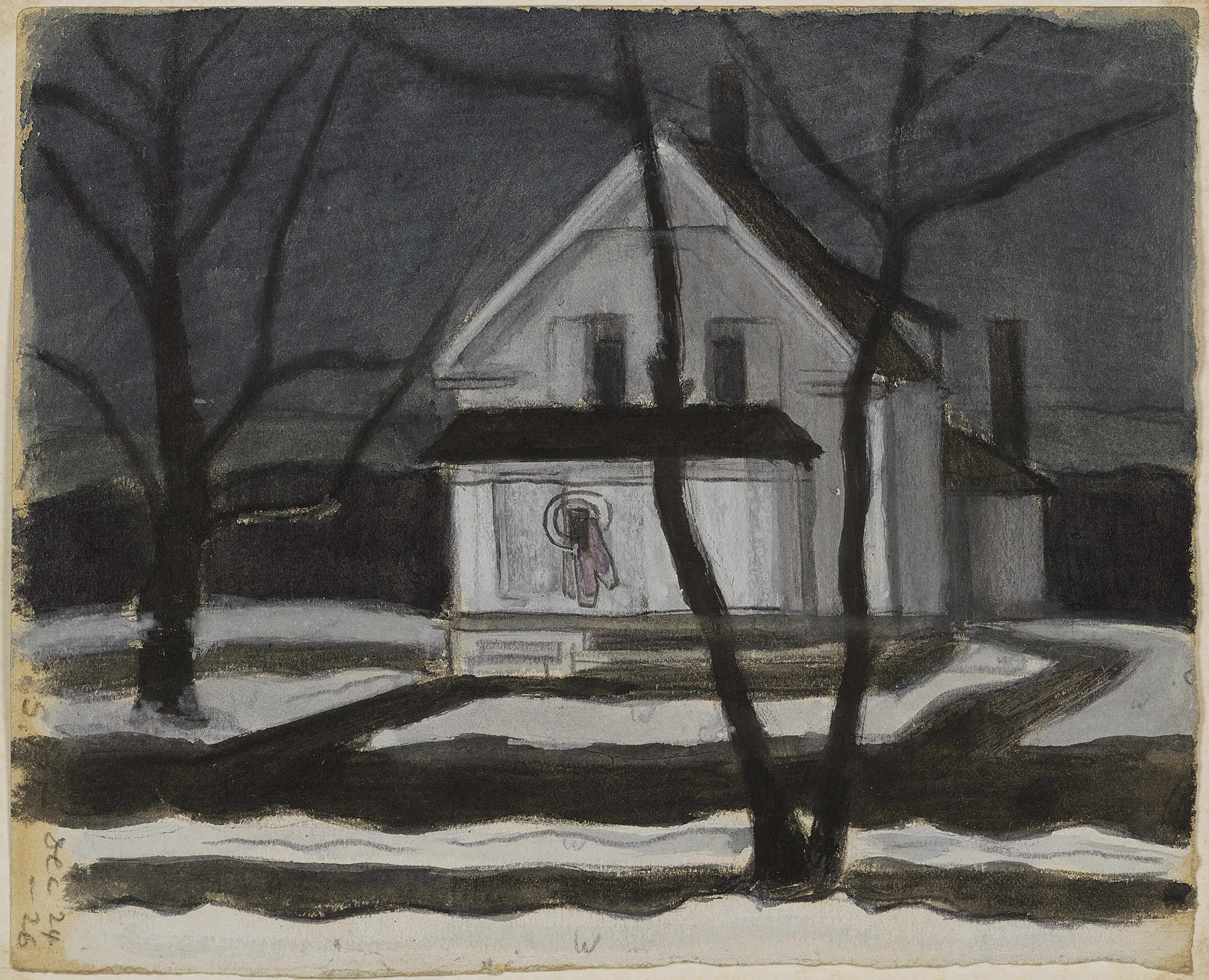
Snow, December, 1926
Oscar BluemnerWatercolor on paper
15 3⁄4 × 7 1⁄8 inches
Dated lower left, scattered inscriptions by the artist
Provenance
Vera Bluemner, New York, the artist’s daughter
Private collection, New York, since 1968
Bluemner’s own words best describe his work from this period: “I prefer the intimate landscape of our common surroundings [for] we carry into them our feelings of pain and pleasure, our moods . . . I am unable to let the simple objects of a scene, a house, a tree, a sky or water be my actors . . . and use shapes resembling theirs to correspond to the respective tones of any personal color theme my imagination conceives. That is, I do not paint an “impossible” nature, but rather an aesthetically-psychologically possible free creation for play upon the spectator’s soul.”[1]
In 1926, Bluemner’s wife Lina died suddenly, and this tragic event prompted him to move with his children to South Braintree, Massachusetts. There, at the age of fifty-nine, the artist entered the final and most prolific phase of his career during which he explored male and female principles, attempted to identify the various dimensions of experience (the physical, the emotional/intellectual/ and the spiritual), and searched for transcendental truths revealed through the senses and the psyche. These late works are among the artist’s most complex. Snow, December, painted the year the artist’s wife died, evokes a cold bleakness in its palette of white and black, contrasted against a midnight blue sky.
[1] Quoted in Hayes, p. xii