Tonita Peña
1893-1949
Around 1920, a group of relatively unknown, mostly self-taught Native American painters from the Pueblos of New Mexico and Arizona gained the attention of the mainstream modern art world. For the first time, artists such as Tonita Peña (1893–1949), Alfonso Roybal (1898–1955), Velino Shige Herrera (1902–1973), and Julian Martinez (1879–1943) were painting on paper—without ritual or functional purposes—as self-consciously independent works of art. Multiple factors fostered this new pictorial tradition, including the artists’ desire to record their cultures, the rise of tourism to the American West, anthropological interest in the region, and the arrival of mainstream artists and collectors such as Georgia O’Keeffe, Robert Henri, and Mabel Dodge Luhan. Within a few years, works by these artists were exhibited widely across the United States and in Europe, appearing at venues from the Chicago Arts Club and the American Museum of Natural History to the Venice Biennale of 1932, where the Native American gallery was installed alongside works by George Bellows and John Sloan.
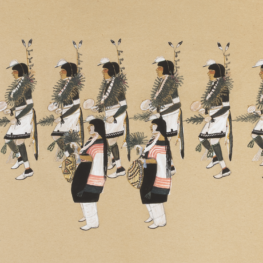
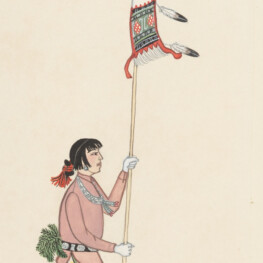
Tonita Peña, the most celebrated first-generation Pueblo painter, was born in 1893 in San Ildefonso Pueblo. Her Pueblo name was Quah Ah, meaning “White Coral Beads,” and she came from a distinguished family of artists. Encouraged by a teacher to use paper and watercolors, her work quickly caught the eye of archaeologist Edgar Lee Hewett, who became a lifelong advocate. Peña became a pioneering figure as the only female painter of her generation—not only adopting a new medium but depicting representational images of Pueblo life previously restricted to male artists. Ritual dances were her principal subject, and through meticulous attention to costume detail, brilliant color, and subtle individualization of figures, she infused her compositions with energy, dignity, and grace. Her dancers move against unarticulated neutral backgrounds—a hallmark of Pueblo painting understood both as a rejection of European illusionistic perspective and as a means of protecting the sanctity of sacred ceremonies. Her reputation was cemented when Basket Dance was purchased at the 1932 Venice Biennale for the Whitney Museum for $225.00, the largest sum paid for a Native American painting to date, and her work is now held in collections including the Museum of Modern Art and the National Gallery of Art.
Together, these painters represented a pivotal moment when the meaning of “American art” was being renegotiated: made with Anglo materials and sold on the conventional art market, their paintings simultaneously declared Native collective identity, sovereignty, and tradition. Praised by critic Walter Pach as “abstract, elemental, and essential,” this pictorial tradition—deeply rooted in revered rituals—went on to influence generations of artists, and its sincerity and serenity continue to draw viewers into a compelling world.