
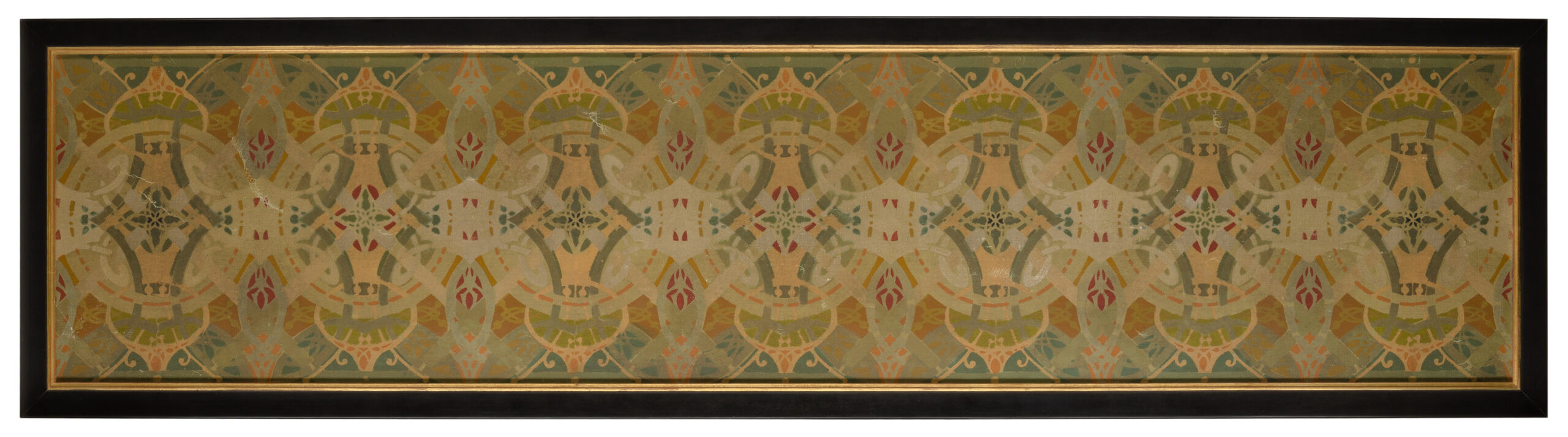
Completed in 1894, Sullivan thirteen-story Chicago Stock Exchange was one of the earliest modern skyscrapers, rising to a new height made possible by developments in steel framing. The second-floor trading room was its magnificent centerpiece. When the building was demolished in 1972, architectural elements were salvaged and gathered by collectors and museums. This particular painted fragment features distinct hues in muted tones of rust and gold, green and yellow. Shapes that recall root systems, stems, and leaves are transformed into stylized patterns that allude to prairie landscapes and the fundamental role of midwestern agriculture in the US economy. The rhythm and precision of the abstract design are also reminiscent of Islamic decorative traditions.
In its lush, organic motifs and intricately stenciled patterns, the frieze reflects Sullivan’s goal of synthesizing elements of nature with abstraction. Organic patterns portrayed at different scales and in various mediums were integrated throughout the entire building, arranged to emphasize the structure’s verticality. Motifs recurred in molded plaster and terra-cotta and in the ironwork of staircases and elevator grilles. Sullivan believed that decorative elements and architectural form could, and should, come together to create a unique and harmonious whole. Through his elaboration of a concept he called “organic ornamentation,” he paved the way for a distinctly American visual culture rooted in the simplicity of nature yet brimming with endless variations of architectural expression.